Friday, 11 October 2013

Top 10 reasons why you should visit Sri Lanka


There are hundreds of reasons for you to visit Sri Lanka… But here’s my list of the top 10 reasons that would make you want to book your flight right now!


1) Heritage

 
The Vatadage in Polonnaruwa


Did you know that Sri Lanka has more UNESCO World Heritage sites than Egypt? That’s pretty impressive for such a tiny Island… Our rich history left us with an incredible collection of ancient ruins that date back to the 1800s. Most of which are adorned with some of the most intricate stone carvings you will ever see. Just that is enough reason for anyone to book a holiday to Sri Lanka.


2) Wildlife


Sri Lanka boasts of its ‘Big Five’ which include the Blue Whale, the Sperm Whale, the Asian Elephant, the Leopard and the Sloth bear. But it’s not just that, we’ve got a lot more to see here. Our jungles and forests are home to a varied collection of animals and bird life as well as insects and reptiles. You don’t have to be a wildlife enthusiast or a naturalist to be awed by what you see on a game drive at one of our many national parks and forests.


The Wildlife at Yala National Park


3) Beaches


Wadduwa Beach

Now this I’m sure you already know about. When someone mentions Sri Lanka, most people would immediately think of its beaches. Why wouldn’t they? We are an island after all and our beautiful country is surrounded by miles and miles of unspoiled beaches. And it’s not just that, you won’t be disappointed when snorkelling and diving off our coastlines because we are home to many beautiful coral reefs and some interesting ship wrecks.


4) Religions


The four main religions in Sri Lanka are Buddhism, Christianity, Hinduism and Islam. Each of them hold a big place in Sri Lanka’s history and there are many beautiful establishments that you will love to see no matter which religion you follow. Kataragama, a religious town in the Southern part of the country has a few Hindu Kovils, a Buddhist Temple, a Mosque and a Church all of which are a short distance from each other. The Sita Amman Kovil in Nuwara Eliya is a place that plays a huge role in the famous story of Rama and Sita.


The art on the pillars of the Temple of the Tooth Relic in Kandy


5) Tropical Climate


One of the things I personally love about Sri Lanka is its climate. Being a tropical country, most of our days are sunny and bright. Most travellers love to show off their holiday tan once they go back home. Sri Lanka is the best place for that. If it’s rainy while you’re here…  that’s still pretty great because if you’re anything like me, I love a nice walk in the rain! It isn’t cold like the winter rainfall that I had to deal with when I was in England!


6) Arts and Crafts


Sri Lanka’s got a lot of art and handicrafts that been around for generations. Whether it is colourful mask [ves-muhuna] that is used to ward off the evil eye or a shopping bag woven out of straw… We’ve got some useful and decorative souvenirs for you to take back to decorate your home with. You’re definitely going to want something to remember the amazing time you had in Sri Lanka!


A Ves-Muhuna

A local form of crochet called Biralu

Purses made out of coloured straw woven together


7) Food


I’m a big time ‘foodie’… So you can trust me when I say, Sri Lanka has so many different and delicious dishes that everyone must try at least once in their lives. There are so many amazing curries, vegetables, fruits and ‘short eats’ that you could spend your entire holiday eating, but you still would not be able to taste all of it! It’s not just Sri Lankan food that you should try either. We’ve put our own spin on food from other countries as well. The Chinese food here might not taste anything like it does in China, but it is so good that you tend to over eat and open the top button of your trousers to give your tummy more space!


My Mom's delicious crab curry


8) People


I know that I’m biased when I say this, but Sri Lankans are very friendly and they most often go out of their way to be hospitable. They would always greet you with a warm Sri Lankan smile. If you’re planning on meeting some friendly people and making friends while on holiday, head down to Sri Lanka and you won’t be disappointed!


The warm Sri Lankan smile!


9) Cheap


One of Sri Lanka’s lesser advertised selling points is how cheap it is to travel here. The food, transport and shopping are far cheaper than most other countries and it is absolutely worth it. It’s only your flight expense that will weigh down your budget. Once you get here though, you’d be pleasantly surprised by how affordable things are.


10) Compact


Reading about all of these reasons to make Sri Lanka your next holiday destination, you might be thinking that it can’t all be done in one holiday. If that is the case, you’re wrong! Unlike India, where everything is so spread out, Sri Lanka is a tiny island. This allows you to see and experience almost all of the things I mentioned. You could be relaxing on a beach and in a few short hours be in the middle of a thick jungle or in the chilly hill country…


Sri Lanka is an amazing country with so much to offer. Come and experience it!


Friday, 6 September 2013

'There' and back again


Aside from the title, this blog post doesn’t have much to do with the hobbits tale written by Bilbo Baggins! Instead, it’s about a very relaxing trip to a bungalow hidden away in Dehiowita. The bungalow named ‘There’ is about an hour and a half away from Colombo and about fifteen minutes from the town of Awissawella.

Pardon my references to The Lord of the Rings, but now as I think back… ‘There’ reminds me a little of Rivendell, the home of the elves that is surrounded by rivers, because of the river and the stream that surrounds it.

 
A painting of Rivendell (thanks to FineArt America)on the left and my attempt to draw a map that shows how the rivers flow around the bungalow on the right.  

The road from Colombo to Dehiowita was good but it was the last bit from Dehiowita to the bungalow that gave us a hard time. It is a possibility for a van or a four wheel drive, but not even an option for a car. We did however manage to get a car up there albeit at a very slow pace by getting out of the vehicle to lighten the load at the difficult points. The bottom of the vehicle got slightly banged up a few times but the car soldiered on and made it to the bungalow in the end. When I was talking to David, the owner of this lovely property, about the road access… He said that he was looking to only fix the bigger potholes on the road instead of paving the entire stretch to deter any other traffic and vehicles that might come that way. He wanted to keep the area peaceful.


I noticed a change in the air the second I stepped out of the vehicle… It was cool, fresh and crisp and we were welcomed with some Kola Kenda, a warm and inviting herbal Sri Lankan porridge. The second thing I noticed was that there was no cell phone reception anywhere. I walked all around the house and the gardens in panic searching for at least one bar of reception but found nothing. After the initial shock of realising I would be offline for two whole days wore off… I started to enjoy the bungalow and its surroundings a lot more. The house is surrounded by lush greenery and the rivers and all you can hear are birds chirping and the peaceful sound of the river rushing past.


The front garden
 
A warm jug of Kola Kenda

 
The flowers that brighten up the garden

My cousin looking for cell phone reception!


Features of the bungalow's facade
The resident stray that paid us a visit!
 
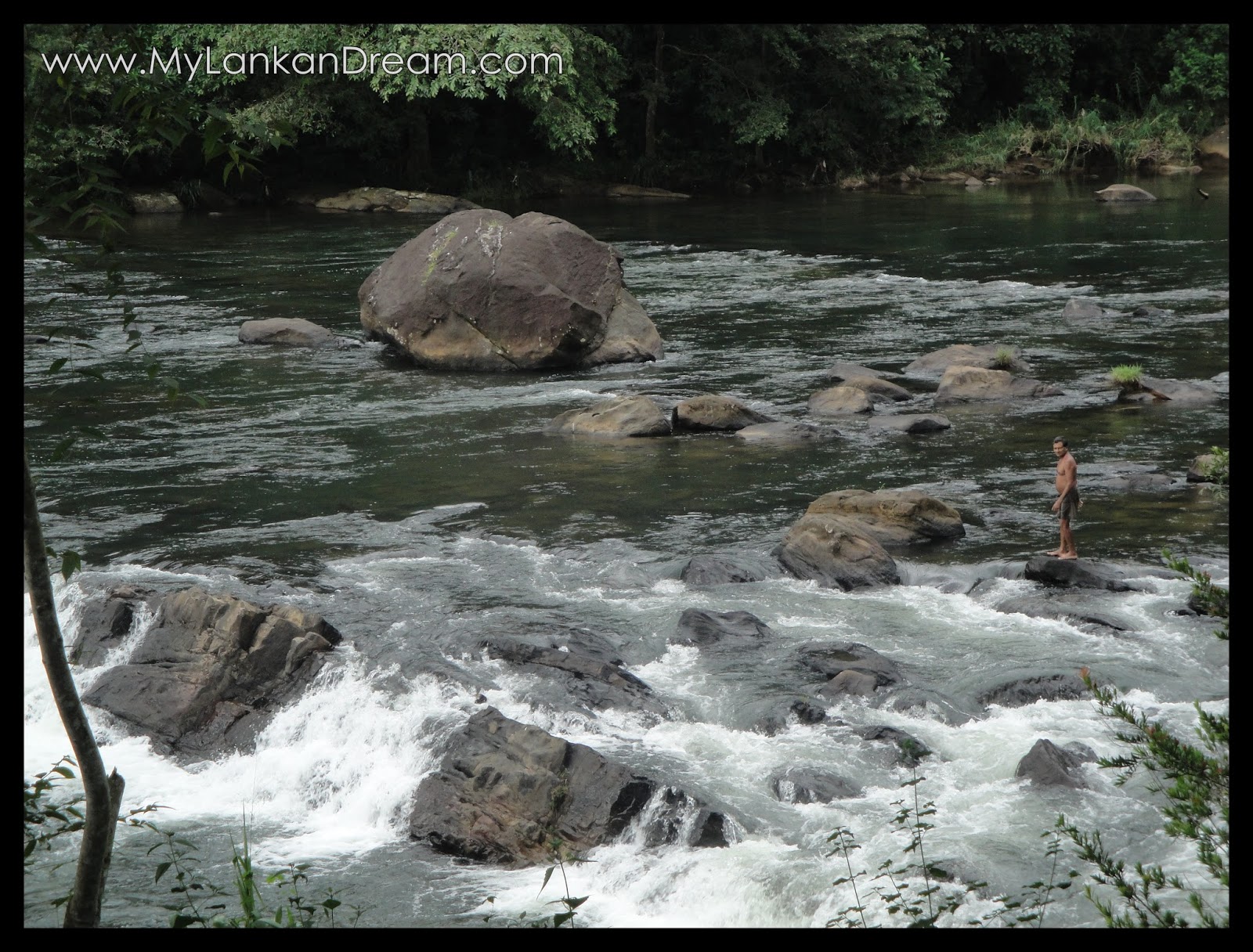
The river

From the veranda
 
The master bedroom, although I would rather sleep out in the veranda!


By afternoon, I was actually happy about being offline and out of cell phone range. It was great to just switch off and take a dip in the stream [because the river was too rough] or play some games with my family. The gardens were full of flowers and big colourful butterflies [the kind you would never see in the city]. Another interesting feature about the bungalow is that the greens used to make the kola kenda, the fruits used to make the fresh juices and the vegetables they cooked for our meals were all grown in their garden. 

The very clear water in the stream

Best seat there was...!

Some mushrooms I found walking back up to the house

The steps from the stream up to the house

The collection of indoor games they had there...!

You find so many pretty things while walking around the gardens....


The fresh juice we were offered and the fruit it was made out of
 
The delicious lunch...

Enjoying the view...


This is an ideal place for someone who wants to just switch off from the city life and enjoy some fresh air. It is also the place the inspired me to create a concept holiday in Sri Lanka that is solely focussed on bathing spots. More on that later! Until then, Live. Love. Travel. 


Monday, 12 August 2013

The Kataragama Festival


One of the Solosmastana [16 places visit by Lord Buddha in Sri Lanka], Kataragama is a popular religious pilgrimage site in the country that is frequented by Hindus, Buddhists, Veddas  [an indigenous people of Sri Lanka ] and Muslims alike. The complex that is on the banks of the Menik Ganga [river of gems] holds the Kataragama Devalaya [a Hindu shrine dedicated to God Kataragama, also known as Skanda-Murukan], the Kiri Vehera [an ancient Buddhist Stupa], a Mosque and several other smaller temples and shrines.

It is believed that God Kataragama lived in the mountain jungles near the Menik Ganga with his Indian wife, Thevani Amma and his Sri Lankan wife Valli Amma. King Dutugemunu visited the deity Kataragama here after his victory against Elara the Chola invader to fulfil his vow by building a shrine dedicated to the deity. Kataragama Deviyo was said to have shot a golden arrow from his home at the peak of the mountain and to have told the King to build the shrine in the location where the arrow had fallen. This is where the Kataragama Devalaya is today. Devotees believe that God Kataragama is a very powerful deity and they worship him to help them overcome their personal problems or for success in business enterprises.

 
The fruits that are offered in trays to the Diety

The entrance to the Kataragama Devalaya

The facade of the Devalaya

 
The Kataragama Festival which usually starts 10 days prior to the full moon day falling in the month of July ends with a final perahera [parade] on that full moon day. This year however, it was delayed by a month for auspicious reasons. Pilgrims flock from all over the country and stand for hours to see this colourful festival take place. The ‘Pada Yatra’ [foot pilgrimage] pilgrims start walking [the entire way] from the Nallur Kovil in Jaffna about two months prior to the start of the Festival, going from one sacred site to another  making their way to the Kataragama Devalaya in the South, growing in size, chanting ‘Haro Hara’ and other ancient praises to strengthen their will.

Although I have been visiting Kataragama frequently all my life, I had never witnessed the festival take place until now. We made our way from Tissamaharama to Kataragama at dusk on Wednesday the 7th of August dressed in white, to be a part of the first perahera of the season. The mahouts were taking the elephants that were going to be a part of the parade to the Kiri Vehera at the same time we were there. The elephants circled the stupa and then bowed down to it before exiting. We then walked alongside the elephants as they went towards the Kataragama Devalaya. They each in turn walked to the front of the shrine and bowed down.

 
A lady selling flowers on the way to the Kiri Vehera

The Tusker leaving the Kiri Vehera after worship

 
In the Perahera, the ‘Yantra’, a spiritual drawing of the Kataragama Deity’s power is taken on the back of a grand Tusker to Valli Amma’s shrine about 300 metres away. It is kept there for a quarter of an hour before it is returned on the back of the same tusker to the Kataragama Deity’s shrine. This parade occurs every night for 10 days. On the last day, it is kept overnight at Valli Amma’s Shrine to resemble their wedding night. It takes about an hour to dress the tusker in sequined clothes and to prepare the housing in which the Yantra is carried. Devotees then cover drape the Tusker in garlands of fresh flowers and spray it with scented water.

Families lighting pahanas before the perahera starts

The crowd gathered to witness the dressing of the Tusker

The Tusker being dressed

Devotees waiting to drape the flower garlands on the Tusker
  
The Perahera starts with the ‘Kasa-Karayo’ [whip-men] who make whipping sounds with their thick chord whips to signal to the onlookers that the parade is approaching. They are followed by the fire dancers who spin around various batons and loops lit on fire while dancing. Next come two sets of Hewisi Bands playing traditional beats and the swami’s of the Pada Yatra Pilgrims. They are then followed by dancers that represent different parts of the country. There were Kandian dancers, Hill Country dancers, Southern dancers, Kavadi dancers and my personal favourite the peacock dancers. The peacock is the transport and the symbol of the Kataragama Deity and this dance depicts the dance of a peacock.


The perahera pathway lit up

One of the Whip-men
The fire dancers

A drummer

One of the Hewisi Bands

The Pada Yatra Swamis
 
A peacock dancer
 

Finally, after another Kandian Hewisi band and more Kandian dancers is the chief of the Vedda Tribe. The Veddas are said to be angry with the Kataragama Deity for wanting to take Valli Amma, one of their own, away to India. Because of this, the Vedda Chief walks backwards, facing the Tusker and pointing his bow and arrow at the Yantra. But then the Veddas respected him for choosing to stay instead and because of this, the Chief worships the Yantra from time to time during the perahera. The Perahera then ends with a pooja [religious ceremony] at the Devalaya.


The Vedda Chief worshiping the Yantra
The Yantra being carried on the back of the decorated Tusker

Whether you are a religious person or not, this spectacularly colourful parade full of religion, culture and history is something you should definitely witness if you visit Sri Lanka during this time of year.